FREE SHIPPING ON ORDERS OVER 100$ IN HALIFAX, NS
FREE SHIPPING ON ORDERS OVER 200$ CANADAWIDE
COLLECT POINTS ON EACH PURCHASE
REFER A FRIEND AND EARN POINTS
CANADAWIDE EXPRESS SHIPPING


Cannabis Glossary: 70+ Canadian Terms Explained


We take great pride in The Smoke Bomb. We’re Halifax’s leading online dispensary of CBD cannabis products. And we celebrate all things cannabis.
Cannabis packaging can feel like it was written for a chemist. One label mentions total THC and terpenes. Another describes live resin, full-spectrum oil or a sativa-dominant cultivar. These terms describe different parts of the product, but they are often treated as if they mean the same thing.
This Canadian cannabis glossary explains the language used for flower, cannabinoids, concentrates, edibles, vapes and product labels. It also corrects several common misconceptions about potency and indica-versus-sativa classifications.
The glossary is educational. A product name, strain category or terpene does not guarantee a particular experience. Effects can change with THC concentration, CBD content, serving size, consumption method, tolerance and individual response.
Understand THC, CBD, terpenes, flower, edibles, concentrates and Canadian cannabis label terms with this plain-language A-to-Z glossary.
Essential Cannabis Terms at a Glance
| Term | Plain-language meaning |
|---|---|
| Cannabis | A plant containing cannabinoids, terpenes and other compounds |
| Flower | The dried, usable flowering portion of the cannabis plant |
| THC | The primary intoxicating cannabinoid in cannabis |
| CBD | A cannabinoid that does not usually produce the intoxicating effects associated with THC |
| Cannabinoid | A class of compounds that includes THC, CBD, CBG and CBN |
| Terpene | An aromatic compound that contributes to the scent and flavour of cannabis |
| Cultivar | A cultivated cannabis variety, often called a strain |
| Concentrate | A product containing concentrated cannabinoids and other plant compounds |
| Edible | Food or drink containing cannabis extract or cannabinoids |
| Total THC | The potential THC content after THCA is converted into THC |
| Potency | The amount or concentration of cannabinoids in a product |
| Dose | The amount consumed at one time |
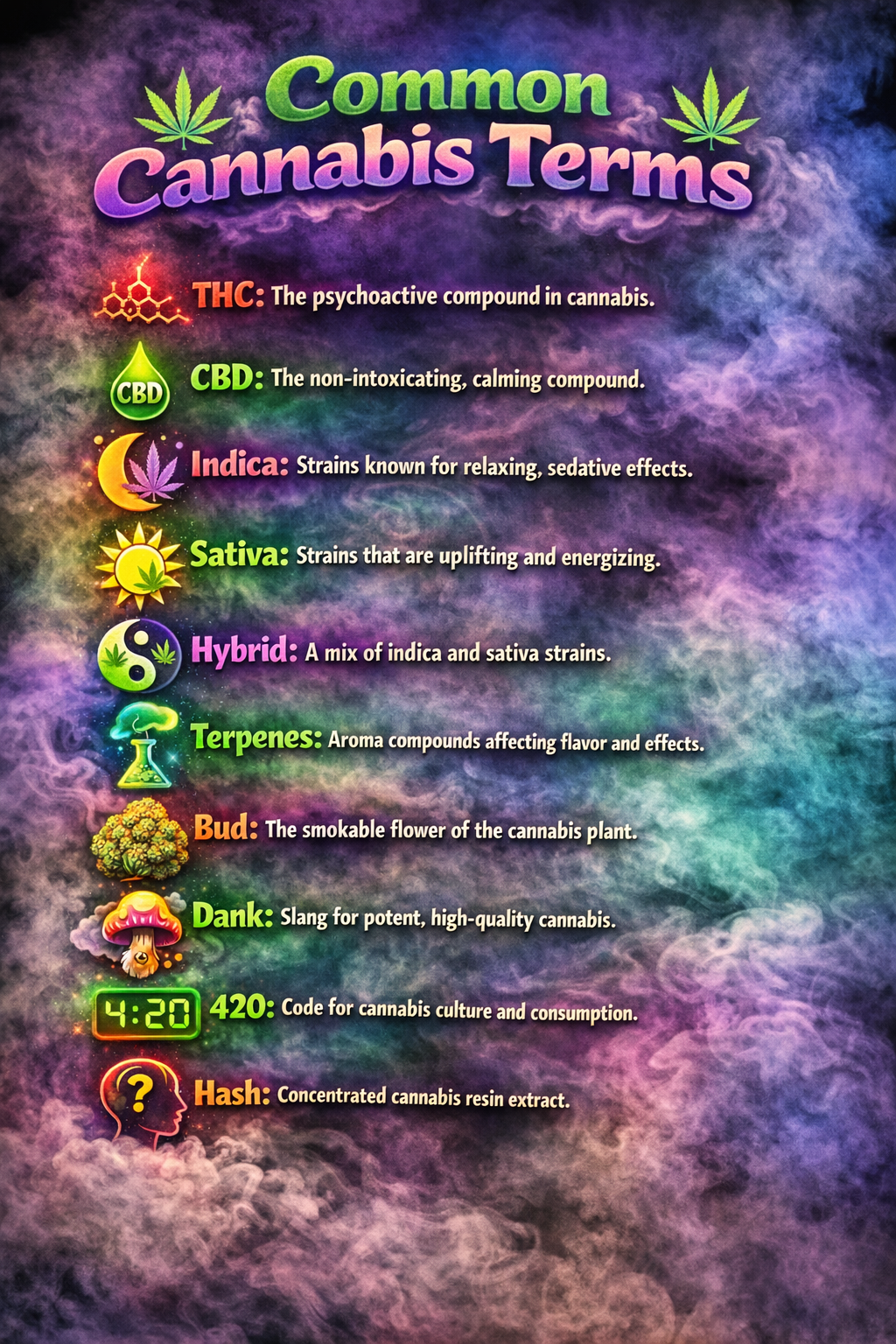
Cannabis Plant and Flower Terms
Here’s a growing list of cannabis terminology to keep you informed and sound like a green thumb regarding cannabis terms.
Cannabis: A Cultural and Medicinal Powerhouse
The Term’s Rich History and Diverse Uses
Cannabis, a plant with a storied history spanning over 2,000 years, plays a significant role in both medicinal and recreational arenas. Originating from the Latin word “cannabis,” it’s also popularly known as marijuana or pot.
This versatile plant, specifically Cannabis Sativa L., is rich in cannabinoids – with over 600 distinct chemical compounds. THC (Tetrahydrocannabinol) and CBD (Cannabidiol) stand out as the primary cannabinoids.
THC is renowned for its psychoactive effects, while CBD, intriguingly, does not induce such effects, leading to its widespread use in therapeutic contexts.
Flower
Flower is the harvested and dried flowering portion of the cannabis plant. It is also commonly called bud.
Cannabinoids and terpenes are concentrated in resin-producing trichomes found across the flower. Flower may be sold whole, milled or inside a pre-roll.
Hash is not another name for flower. It is a concentrated product made by collecting and compressing trichomes.
Bud
Bud is an informal term for cannabis flower. A single piece may also be called a nug or nugget.
Cultivar
A cultivar is a cultivated plant variety selected for particular characteristics. In cannabis, those characteristics may include cannabinoid content, terpene profile, growth pattern, aroma or appearance.
Cultivar is often more precise than “strain,” although strain remains the more familiar retail term.
Strain
Strain is the common retail term for a named cannabis variety, such as Blue Dream or Pink Kush.
A strain name alone does not guarantee the same chemical profile across different growers or batches. Consumers can learn more from the product’s THC, CBD, dominant terpenes and lot information than from its name alone.
Indica, Sativa and Hybrid
Indica, sativa and hybrid are traditional cannabis categories. Retailers often use them as shorthand for expected experiences:
- Indica commonly suggests relaxing or physically heavy effects.
- Sativa commonly suggests uplifting or mentally stimulating effects.
- Hybrid suggests characteristics associated with both categories.
These labels are not reliable predictions. Products sold under the same category can have different cannabinoids and terpene profiles. Personal tolerance, dose and consumption method can also influence the experience.
For more useful comparisons, examine the product’s cannabinoid content, terpene information and potency rather than relying only on indica or sativa.
Cannabinoid: The Plant’s Active Alchemy
Complex Interactions with the Human Body
Cannabinoids, numbering over 100, are the quintessence of cannabis’ effects. These compounds interact with the body’s CB1 and CB2 receptors, influencing functions like sleep, appetite, and pain management.
Cannabis Terpenes
Terpenes are behind the variety of scents and flavours that give each strain their unique characteristics. Cannabis contains more than 120 identified terpenes. Terpenes are the second most common compounds found in cannabis after cannabinoids, and they do much more than contribute to the plants scent.
Cannabis Tricomes
Cannabis trichomes are tiny, crystal-like glands on cannabis plants, often appearing frosty, that produce and store cannabinoids (like THC, CBD), terpenes, and flavonoids, giving the plant its aroma, effects, and protective qualities against pests and UV rays. Their color changes (clear to milky white to amber) signal maturity, guiding harvest time for desired effects, with milky white indicating peak THC for uplifting effects and amber signaling THC degradation into calming CBN for sedative effects
Cannabidiol (CBD): A Non-Psychoactive Marvel
Therapeutic Applications
CBD stands for cannabidiol. It does not generally cause the intoxication associated with THC, but it still affects the body and can interact with some medications.
A CBD product is not automatically THC-free. Consumers should check both the CBD and THC values on the package.
THC
THC stands for delta-9-tetrahydrocannabinol. It is the main cannabinoid responsible for cannabis intoxication.
THC can affect attention, coordination, reaction time, perception and short-term memory. The experience varies with dose, product type, tolerance and individual sensitivity.
THCA
THCA stands for tetrahydrocannabinolic acid. It is the acidic precursor to THC found in raw cannabis.
Heat causes THCA to convert into THC through a process called decarboxylation. Smoking, vaping and cooking can trigger this conversion.
Total THC
Total THC estimates the amount of THC available after THCA has been converted into THC.
On Canadian cannabis labels, “THC” and “Total THC” may appear as separate values. The first number describes the THC present before activation. The total value accounts for the potential contribution of THCA.
Health Canada requires regulated cannabis labels to display THC and CBD quantities or concentrations. Health Canada’s label guide explains how these amounts appear on different product formats.
CBDA
CBDA stands for cannabidiolic acid. It is the acidic precursor to CBD found in raw cannabis. Heat can convert CBDA into CBD.
CBG
CBG stands for cannabigerol. It is one of several cannabinoids found in cannabis, usually at lower concentrations than THC or CBD.
CBGA, its acidic precursor, participates in the plant’s production of several other cannabinoids. This is why CBG is sometimes informally called a “parent” or “minor” cannabinoid.
CBN
CBN stands for cannabinol. It can form as THC oxidizes and degrades over time.
CBN is often marketed in products associated with nighttime use, but marketing language should not be treated as proof that a product will improve sleep.
Dose
A dose is the amount consumed at one time. It should not be confused with package potency.
For example, an edible package may contain several pieces. The total package could contain more THC than a single serving. Consumers should check the amount per unit and the amount in the entire container.
Milligram
A milligram, abbreviated mg, measures an amount of THC, CBD or another ingredient.
Milligrams are commonly used on edibles, capsules, oils, beverages and extracts.
Milligrams per Gram
Milligrams per gram, written as mg/g, express concentration by weight.
A value of 200 mg/g is approximately equal to 20% by weight. This conversion is especially useful when comparing older percentage-based flower descriptions with Canadian labels.
Potency
Potency describes the concentration or amount of cannabinoids in a product.
For dried flower, potency is often expressed in milligrams per gram or as a percentage. Edibles usually show THC and CBD in milligrams per unit and per package.
High potency does not necessarily mean high quality. Freshness, aroma, moisture, processing, formulation and personal preference also affect how a product is evaluated.
Cannabis Dispensary: A Hub of Healing and Recreation
Dispensaries and Cooperatives Explained
Cannabis dispensaries are specialized stores offering cannabis products. In the medical realm, they are often termed ‘marijuana cooperatives.’
Cannabis Edibles: A Delicious Dose of Relief
The Culinary Cannabis Experience
Cannabis edibles transform cannabinoids into gastronomic delights. Ranging from brownies to candies and beverages, these edibles infuse THC and CBD oils into various food forms, offering an alternative consumption method.
Cannabis Flowers: The Essence of Potency
Understanding the Female Cannabis Plant
Cannabis flowers, primarily from female plants, are the epicenter of THC and CBD concentration. These flowers, when dried and smoked, release their potent effects. Known as buds, nugs, or hash, they are central to the cannabis experience.
Cannabis Oils: Concentrated Cannabis Essence
Extraction Techniques and Applications
Cannabis oils, extracted using solvents like ethanol or CO2, offer a potent form of cannabis. Unlike hash oil, which contains only certain cannabinoids, cannabis oils encompass the full spectrum of the plant’s compounds. These oils are commonly used in dabbing, vaporizing, and cooking.
Hemp: Cannabis’s Versatile Cousin
Industrial and Medicinal Uses
Hemp, a cannabis variant with less than 0.3% THC, is prized for its fiber and seeds. Legally distinct in Canada, hemp is used for its CBD oil, which lacks THC’s psychoactive properties but offers therapeutic benefits, including anti-inflammatory effects.
Indica: The Relaxing Strain
Physical Characteristics and Effects
Indica, known for its calming and sedative properties, is characterized by its short, bushy stature and broad leaves. With higher CBD levels than THC, Indica strains are favored for pain relief and insomnia management.
Pre-Roll
A pre-roll is cannabis flower that has already been ground and rolled in paper. Some pre-rolls contain only flower. Others may include kief, hash, resin or another concentrate and are commonly described as infused pre-rolls.
Ready-to-Smoke Joints
Pre-rolls are pre-rolled joints, often containing high-quality cannabis flower, providing a ready-to-use option for consumers.
Infused Pre-Roll
An infused pre-roll combines cannabis flower with a concentrate. The added material may be placed inside the roll, mixed with the flower or applied to the outside.
Infused pre-rolls can contain substantially more THC than standard flower-only pre-rolls. Consumers should check the label rather than judging potency from size.
Sativa: The Energizing Strain
Cerebral Highs and Daytime Use
Sativa strains are celebrated for their energizing effects and cerebral highs. They generally have higher THC content and are favored for daytime use and social activities.
THC (Tetrahydrocannabinol): The Psychoactive Component
Understanding Marijuana’s ‘High’
THC is the main psychoactive component in marijuana, responsible for the plant’s mind-altering effects. Also read about What is HHC here.
A-B-C: A Cannabis Classification System
Understanding Cannabinoid Content
The A-B-C method classifies cannabis strains based on cannabinoid content, primarily THC, CBD, CBG, and CBC. THC is responsible for marijuana’s psychoactive effects, while CBD offers therapeutic properties without the high. CBG is a precursor to THC, and CBC has anti-inflammatory properties.
Adulterants: Hidden Additives in Cannabis Products
Adulterants in cannabis products, added to increase weight or appearance, can include inert materials like sand or glass beads. It’s crucial to be aware of these additives, which can impact quality and health.
Air-conditioning Effect: A Sensory Phenomenon
Understanding Temperature Sensations while Smoking
The ‘air-conditioning effect’ refers to the sensation of feeling unusually hot during marijuana consumption. This can be attributed to various factors, including impaired lung air circulation in conditions like asthma or bronchitis. Additionally, certain marijuana strains with higher THC concentrations may exacerbate this sensation by increasing body temperatures during consumption.
Read More – https://en.wikipedia.org/wiki/Glossary_of_cannabis_terms
Kief
Kief consists mainly of detached cannabis trichomes. It looks like a fine, sticky powder and often collects in the bottom chamber of a multi-stage grinder.
Because trichomes contain much of the plant’s cannabinoid-rich resin, kief is generally more concentrated than ordinary flower.
Hash or Hashish
Hash is a cannabis concentrate made by collecting and compressing trichomes. Production methods include dry sifting, hand rolling and ice-water separation.
Texture and colour vary with the plant material, processing method, heat and pressure used.
Hemp
Industrial hemp is cannabis cultivated and regulated for industrial purposes under Canadian law. It may be used to produce fibre, grain, seed, food ingredients and other materials.
Hemp seed oil should not be confused with CBD oil. Hemp seed oil is pressed from seeds, while CBD products are made using cannabinoid-containing plant material.
Cannabis Terpene and Aroma Terms
Terpene
A terpene is an aromatic compound produced by cannabis and many other plants. Terpenes contribute to a product’s scent and flavour.
Cannabis may smell citrusy, floral, piney, earthy or peppery because of its terpene profile. Terpenes are volatile, which means heat, light, oxygen and poor storage can cause them to deteriorate.
Terpenes should not be treated as guaranteed effect markers. A product containing myrcene, for example, will not necessarily make every consumer feel sleepy. THC concentration, dose, other compounds and individual response still matter.
Our guide to common cannabis terpene profiles explains how six frequently discussed terpenes differ in aroma.
Terpene Profile
A terpene profile describes the combination and relative concentration of terpenes detected in cannabis.
A profile provides more information than a single dominant-terpene label. Two products can both contain limonene but smell and taste different because their supporting terpenes occur in different proportions.
Myrcene
Myrcene is a terpene with earthy, herbal, musky and sometimes fruity aromas. It is also found in hops, mangoes and lemongrass.
Myrcene is frequently associated with relaxing cannabis products, but its presence does not prove that a product will cause sedation.
Limonene
Limonene produces citrus-like aromas associated with lemon and orange peel. It occurs in citrus fruit rinds and many other plants.
A citrus smell does not reveal how much THC a product contains. Aroma and cannabinoid potency describe different product attributes.
Beta-Caryophyllene
Beta-caryophyllene is a terpene associated with black pepper, cloves, wood and spice. It is unusual because it can also interact with the body’s CB2 cannabinoid receptors.
Its presence should not be presented as evidence that a cannabis product treats pain, anxiety or inflammation.
Pinene
Pinene has a pine, herb or fresh-wood aroma. Alpha-pinene and beta-pinene are related but distinct compounds.
Pinene appears in pine trees, rosemary, basil and other plants. Claims that it guarantees focus or reverses THC-related memory impairment remain too strong for a consumer glossary.
Linalool
Linalool is a floral terpene also found in lavender and numerous herbs. Cannabis products containing it may have floral, sweet or lightly spicy notes.
Linalool is often marketed alongside evening products. That positioning is not proof that it will improve sleep.
Humulene
Humulene is associated with earthy, woody and hop-like aromas. It occurs in hops, basil and some cannabis cultivars.
Claims that humulene suppresses appetite should not be used to predict the effects of a finished cannabis product.
Flavonoid
Flavonoids are plant compounds that contribute to colour, flavour and other biological characteristics. Cannabis contains flavonoids, cannabinoids and terpenes, but these are separate chemical groups.
Entourage Effect
The entourage effect is the hypothesis that cannabinoids, terpenes and other cannabis compounds may interact to produce effects that differ from those of an isolated compound.
The idea remains under study. It should not be treated as a formula that can predict exactly how a terpene and cannabinoid combination will affect an individual.
Cannabis Consumption Terms
Consumption Method
A consumption method is the way cannabis enters or is applied to the body.
Common formats include:
- Inhaling smoke from combusted flower
- Inhaling aerosol from a vaporizer
- Eating or drinking an edible
- Swallowing an oil or capsule
- Using a product under the tongue
- Applying a topical product to the skin
The format can influence onset time, duration, dose control and intensity. Our detailed guide compares common cannabis consumption methods.
Combustion
Combustion means burning cannabis and inhaling the resulting smoke. Joints, pipes and water pipes are combustion methods.
Combustion is different from vaporization. A vaporizer heats material to produce an inhalable aerosol without intentionally burning it, although the temperatures and performance of devices vary.
Joint
A joint is ground cannabis flower rolled in paper. It may include a paper filter or mouthpiece.
A joint containing tobacco is commonly called a spliff. Terminology varies between regions.
Blunt
A blunt generally refers to cannabis rolled in a cigar-style wrap or tobacco leaf. Some modern wraps are tobacco-free, so consumers should check the material instead of relying on the name alone.
Bong or Water Pipe
A bong is a water pipe used to inhale cannabis smoke. The smoke passes through water before inhalation.
Water may cool the smoke, but it does not make combustion harmless or remove all hazardous substances.
Vaporization
Vaporization uses heat to release cannabinoids and aromatic compounds without intentionally burning the cannabis material.
Dry-herb vaporizers heat flower. Concentrate vaporizers heat cannabis extracts. These products require different chambers, temperature ranges and equipment.
Vape Cartridge
A vape cartridge is a container filled with cannabis extract designed to connect to a compatible battery.
Many cartridges use a standard 510-thread connection. Others are made for closed, brand-specific pod systems.
510 Thread
A 510 thread is a widely used screw connection between a vape cartridge and battery. Compatibility also depends on cartridge dimensions, voltage and device design.
Disposable Cannabis Vape
A disposable cannabis vape combines the extract, heating element and battery in one unit. Some are rechargeable but are still called disposable because the oil chamber is not designed to be refilled.
Edible
An edible is food or drink containing cannabis extract or cannabinoids. Examples include gummies, chocolates, baked products, capsules and beverages.
Edible cannabis usually has a slower onset than inhaled cannabis. Effects may also last longer. A person should read the amount per unit and per package before deciding how much to consume.
The Cannabis Edibles 101 guide provides a more detailed comparison of edible formats.
Onset
Onset is the amount of time between consuming cannabis and first noticing its effects.
Onset is affected by the consumption method. Inhaled cannabis generally acts faster than swallowed cannabis. Food intake, metabolism, dose and product formulation can also change the timing.
Duration
Duration describes how long noticeable effects remain.
A fast onset does not necessarily mean a short or mild experience. Product type, THC amount and personal sensitivity influence duration.
Oral Cannabis
Oral cannabis is swallowed and processed through the digestive system. Edibles, capsules and some oils are oral products.
Sublingual Use
Sublingual use means placing a suitable product under the tongue. Some oils and sprays are designed for this route, but consumers should follow the product instructions.
Not every cannabis oil is intended for sublingual use.
Tincture
A tincture traditionally refers to a plant extract made with alcohol. In cannabis retail, the word is also used loosely for liquid cannabinoid products made with carrier oil.
The ingredient list reveals whether the product is actually alcohol-based or oil-based.
Topical
A topical is a cannabis-containing product applied externally to the skin. Examples include creams, balms and lotions.
A topical should not be swallowed or applied to damaged skin unless its instructions specifically permit that use. Topical does not mean transdermal.
Transdermal
A transdermal product is formulated to carry active ingredients through the skin and into systemic circulation. A standard cannabis cream or balm should not automatically be described as transdermal.
Cannabis Concentrate and Extract Terms
Cannabis Concentrate
A cannabis concentrate contains a higher concentration of cannabinoids or resin than ordinary flower. Hash, rosin, resin, shatter, wax and cannabis oil are examples.
Concentrates can differ in potency, texture, aroma, extraction method and intended use. Our guide to cannabis concentrate types explores these differences in greater depth.
Extract
An extract is made by separating desired compounds from cannabis plant material. Manufacturers may use solvents, mechanical pressure, heat, water or combinations of these methods.
“Extract” and “concentrate” overlap, but they are not perfect synonyms. Kief and some forms of hash are concentrates created without solvent-based extraction.
Solvent-Based Extraction
Solvent-based extraction uses a substance such as carbon dioxide, ethanol, butane or propane to separate cannabinoids and terpenes from plant material.
The solvent must later be removed or reduced according to the production method and applicable standards. Consumers should not attempt volatile-solvent extraction at home.
Solventless Concentrate
A solventless concentrate is produced without chemical extraction solvents. Mechanical pressure, heat, ice water or dry sifting may be used instead.
Solventless does not automatically mean more potent, purer or safer. Product quality still depends on the input material, processing and handling.
Dab
A dab is a small portion of cannabis concentrate intended for vaporization on a heated surface or in a concentrate-compatible device.
“Dabbing” refers to the method. The word does not identify a particular concentrate type.
Dab Rig
A dab rig is a device designed for vaporizing concentrates. It commonly uses a heated nail or banger rather than a bowl intended for flower.
Shatter
Shatter is a brittle, glass-like cannabis extract. Its texture results from its composition and processing.
Clarity is not a dependable measure of purity or quality. A transparent extract is not automatically safer or stronger than an opaque one.
Wax
Wax is a soft, opaque concentrate with a wax-like texture. The name describes consistency, not one specific extraction method or cannabinoid profile.
Budder
Budder is a whipped concentrate with a smooth, butter-like consistency. It is sometimes spelled “badder,” although sellers may use those terms for slightly different textures.
Badder or Batter
Badder is a soft, pliable concentrate with a consistency resembling cake batter. It is generally easier to portion than brittle shatter.
Product naming is not standardized across all producers. One brand’s badder may resemble another brand’s budder.
Crumble
Crumble is a dry, porous concentrate that breaks apart easily. It is usually less sticky than wax or badder.
Cannabis Diamonds
Cannabis diamonds are crystalline structures composed mainly of THCA. They may be sold alone or combined with terpene-rich sauce.
THCA converts into THC when sufficiently heated. The product label remains the best source for its reported cannabinoid concentration.
Terp Sauce
Terp sauce is a viscous cannabis extract containing a relatively terpene-rich liquid fraction. It may also contain cannabinoid crystals.
The name refers to composition and texture. It does not guarantee a particular flavour, potency or experience.
Resin
Resin is the sticky material produced by cannabis trichomes. In product terminology, “resin” may also refer broadly to extracts derived from that material.
Because the word is used in several ways, terms such as live resin and cured resin provide more useful information.
Live Resin
Live resin is an extract made from cannabis that is typically frozen shortly after harvest rather than dried and cured first.
The process is intended to preserve more of the plant’s volatile aromatic compounds. “Live” describes the starting material and processing approach. It does not mean the finished concentrate contains living material.
Cured Resin
Cured resin is produced from cannabis that was dried and cured before extraction. Its aroma and consistency can differ from live resin because curing changes the plant material before processing.
Rosin
Rosin is a solventless concentrate made using heat and pressure. It can be pressed from flower, kief or hash.
Rosin and resin are different products despite their similar names.
Live Rosin
Live rosin is a solventless concentrate usually made from fresh-frozen cannabis. The material is commonly processed into ice-water hash and then pressed using heat and pressure.
Distillate
Cannabis distillate is a refined extract with a high concentration of selected cannabinoids, often THC or CBD.
Distillation removes or separates many of the compounds found in the original plant material. Terpenes may be added back into a finished formulation for aroma, flavour or viscosity.
Isolate
An isolate is a highly refined product consisting predominantly of one cannabinoid, such as CBD isolate.
An isolate differs from broad-spectrum and full-spectrum extracts because most other cannabis compounds have been removed.
Full-Spectrum Extract
Full-spectrum generally describes an extract intended to retain a broad range of compounds from the cannabis plant, potentially including cannabinoids and terpenes.
The term does not have one universally applied consumer definition. The product label and testing information provide more useful detail than “full-spectrum” alone.
Broad-Spectrum Extract
Broad-spectrum generally describes an extract containing several cannabis compounds while excluding or substantially reducing THC.
The term should not be interpreted as a guarantee that a product contains zero THC. The measured THC value is what matters.
RSO
RSO stands for Rick Simpson Oil. It is a thick, highly concentrated cannabis extract commonly intended for oral use.
RSO can contain a substantial amount of THC. It should not be treated as a proven cure for cancer or other diseases. Medical claims associated with its name exceed the evidence available for a retail glossary.
CO2 Oil
CO2 oil is cannabis extract produced using carbon dioxide as the extraction solvent. Pressure and temperature allow carbon dioxide to separate selected compounds from plant material.
The final composition depends on the starting material, extraction settings and later refinement.
Honey Oil
Honey oil is an informal name for a translucent amber cannabis extract. The term describes appearance and consistency more than a standardized production method.
Common Cannabis Terms People Confuse
| Terms | Important difference |
|---|---|
| Cannabis and marijuana | Cannabis is the formal Canadian term; marijuana is an older common name |
| Flower and hash | Flower is dried plant material; hash is concentrated trichome material |
| THC and THCA | THC is intoxicating; THCA is its acidic precursor and converts with heat |
| CBD and CBDA | CBD is the neutral cannabinoid; CBDA is its acidic precursor |
| Potency and dose | Potency measures concentration; dose is the amount consumed |
| Terpene and cannabinoid | Terpenes contribute aroma; cannabinoids include THC and CBD |
| Resin and rosin | Resin is plant resin or an extract; rosin is made with heat and pressure |
| Live resin and live rosin | Live resin uses extraction solvents; live rosin is produced without them |
| Distillate and full-spectrum extract | Distillate is highly refined; full-spectrum aims to retain a broader compound range |
| Topical and transdermal | A topical acts at the application area; a transdermal product is designed for systemic absorption |
| Vape and smoke | Vaping heats material; smoking burns it |
| Hemp seed oil and CBD oil | Hemp seed oil comes from seeds; CBD oil contains extracted cannabidiol |
Health Canada limits cannabis extracts to 1,000 mg of THC per immediate container, while additional per-unit and dispensing rules apply to some ingestible extracts. These legal maximums describe packaging limits, not recommended personal doses. Health Canada’s cannabis composition guide provides the current technical requirements.
Canadian Cannabis Label Terms
Standardized Cannabis Symbol
The standardized cannabis symbol is the red octagonal symbol featuring a white cannabis leaf and the letters “THC.”
It appears on the front of regulated cannabis products containing more than 10 micrograms of THC per gram, including the potential conversion of THCA into THC. Its presence warns consumers that the product contains THC. It does not indicate the product’s strength.
Excise Stamp
A cannabis excise stamp indicates that the packaged product came from a federally licensed cannabis processor and that the applicable excise duty requirements were addressed.
Each province and territory uses a different stamp colour. Some prescription and very low-THC products may not require one.
An excise stamp does not show whether a product is fresh, potent or appropriate for a particular consumer.
Health Warning
Regulated cannabis products display a health warning in a yellow box on the front panel. These warnings provide information about potential risks and effects.
The warning is required product information, not promotional copy.
THC
The THC value on a Canadian label describes the amount of active THC in the product before additional THCA is converted through heat.
For dried flower, the initial THC number may appear much lower than the total THC number. Consumers usually compare the total THC values when evaluating potential potency.
Total THC
Total THC represents the potential amount of THC after THCA is converted into active THC.
Health Canada permits different units depending on product format:
- Dried cannabis: milligrams per gram
- Edibles: milligrams per unit and package
- Oils and sprays: milligrams per millilitre or activation
- Vape extracts: milligrams per gram or total quantity
A package containing four edible pieces may show 2.5 mg of THC per piece and 10 mg for the entire package. Confusing the per-unit amount with the package total can lead to accidental overconsumption.
CBD
The CBD number states how much active CBD is present before CBDA conversion.
Total CBD
Total CBD includes the potential CBD available after CBDA is converted into CBD.
A CBD-dominant product may still contain THC. Both values should be checked when intoxication is a concern.
Percentage by Weight
Percentage by weight describes how much of a dried product consists of a particular cannabinoid.
A flower labelled 200 mg/g total THC contains approximately 20% total THC by weight.
To convert milligrams per gram into an approximate percentage, divide the mg/g value by 10:
| Label value | Approximate percentage |
|---|---|
| 50 mg/g | 5% |
| 100 mg/g | 10% |
| 150 mg/g | 15% |
| 200 mg/g | 20% |
| 250 mg/g | 25% |
| 300 mg/g | 30% |
This conversion works for concentrations measured in milligrams per gram. It should not be used for a product labelled in milligrams per package or per unit.
Net Weight
Net weight states how much cannabis product is inside the package, excluding the packaging.
Net weight is different from the product’s possession equivalency.
Dried-Cannabis Equivalency
Dried-cannabis equivalency converts different product formats into an amount equivalent to dried cannabis. It is used to calculate the federal public possession limit.
Adults may possess up to 30 grams of dried cannabis, or its equivalent, in public for non-medical purposes under federal law. Health Canada provides an official cannabis possession-limit calculator.
Equivalency does not compare potency. Two products with the same possession equivalency can contain different amounts of THC.
Lot Number
A lot number identifies a specific production batch. It supports product tracking, testing records and recalls.
A product name may remain the same while its cannabinoid and terpene profile changes between lots.
Packaged-On Date
The packaged-on date identifies when the product entered its final packaging. It is not necessarily the harvest date or manufacturing date.
A recent packaging date does not guarantee freshness if the cannabis was stored for an extended period before packaging.
Expiry Date
Most dried cannabis products do not display a conventional expiry date. Other cannabis formats may include expiry or stability information when required or established by the producer.
Consumers should still inspect products for damaged packaging, contamination, unexpected odours or major texture changes.
Ingredient List
Edibles, extracts and topicals may contain ingredients in addition to cannabis extract.
The ingredient list helps identify:
- Carrier oils
- Flavouring agents
- Sweeteners
- Allergens
- Emulsifiers
- Other formulation ingredients
A cannabis oil and a vape oil are not automatically interchangeable. The product format and instructions determine how it is intended to be used.
Nutrition Facts Table
Edible cannabis products may include a Nutrition Facts table similar to other packaged foods. It describes nutritional information, not cannabinoid potency.
THC and CBD amounts appear elsewhere on the cannabis label.
Intended Use
The intended-use statement identifies how a product should be consumed or applied. Examples include inhalation, ingestion or topical application.
Using a product through a different route may create unpredictable risks. Vape extracts should not be swallowed unless the label explicitly identifies oral use, and oral oils should not be placed in a vape device.
Activation
An activation is one measured operation of a dispensing device, such as one pump or spray.
The label may state the amount of THC or CBD released per activation. The number should not be assumed to represent a suitable personal dose.
Child-Resistant Packaging
Legal cannabis products generally use child-resistant packaging designed to reduce accidental access.
Child-resistant does not mean childproof. Cannabis products should remain closed and stored securely away from children and pets.
For examples of these label elements, consult Health Canada’s guide to reading a cannabis product label.
Canadian Cannabis Legal Terms
Cannabis Act
The Cannabis Act is the federal law that regulates the production, distribution, sale and possession of cannabis in Canada.
Provinces and territories can impose additional rules concerning legal age, retail distribution, public consumption and possession.
Cannabis Regulations
The Cannabis Regulations contain detailed federal requirements for cannabis licensing, production, packaging, labelling, product composition and related activities.
Legal Cannabis
Legal cannabis is produced, packaged and sold through channels authorized under federal and provincial law.
A professional-looking website, delivery service, package or product label does not by itself establish legal authorization.
Licensed Processor
A licensed processor holds federal authorization to manufacture, package or label cannabis products within the activities permitted by its licence.
Licensed Cultivator
A licensed cultivator holds federal authorization to grow cannabis within the activities and limits of its licence.
Authorized Retailer
An authorized online retailer of cannabis in nova scotia is permitted to sell non-medical cannabis under the applicable provincial or territorial system.
Retail authorization differs across Canada. A retailer operating legally in one province is not automatically authorized to sell in another.
Medical Cannabis
Medical cannabis refers to cannabis accessed under Canada’s medical-cannabis framework with authorization from a healthcare practitioner.
Recreational and medical cannabis are governed through related but distinct access systems. A product being called “medicinal” by a seller does not make it an authorized medical product.
Non-Medical Cannabis
Non-medical cannabis is cannabis used outside the medical-access framework. It is also commonly called recreational or adult-use cannabis.
“Recreational” describes the access system. It does not mean the product is risk-free.
Public Possession Limit
Under federal law, an adult may generally possess up to 30 grams of dried cannabis or its equivalent in public for non-medical purposes.
Different equivalency calculations apply to fresh cannabis, edibles, liquids, concentrates and other product classes.
Home Cultivation
Federal law generally permits adults to grow up to four cannabis plants per residence for personal use, subject to provincial, territorial, housing and lease restrictions.
The limit applies to the residence, not separately to every adult living there.
Impaired Driving
Cannabis-impaired driving means operating a vehicle while cannabis has impaired the driver’s ability.
There is no strain, format or consumption technique that makes impaired driving lawful. Nova Scotia warns that a cannabis-impaired driving conviction can lead to fines, licence suspension, imprisonment and a criminal record. Nova Scotia impaired-driving information
Cannabis Terms Specific to Nova Scotia Consumers
Legal Age in Nova Scotia
The legal age to buy, possess, grow or use cannabis in Nova Scotia is 19.
NSLC
NSLC stands for Nova Scotia Liquor Corporation. Under Nova Scotia’s recreational cannabis system, the NSLC is the province’s authorized retailer.
Nova Scotia warns that purchasing cannabis from another source may result in penalties. The rules and minimum fines were updated in 2026, so consumers should consult the province’s current cannabis laws and penalties rather than relying on older blog posts.
Smoke-Free Places Act
Nova Scotia’s Smoke-free Places Act restricts smoking and vaping in designated public places. Municipal bylaws may impose additional restrictions.
Legal possession does not create a right to consume cannabis anywhere.
Household
For home-growing rules, a household or residence is treated as one location. The federal four-plant limit is not multiplied by the number of adults in the home.
Landlords, condominium rules and housing agreements may impose further restrictions.