FREE SHIPPING ON ORDERS OVER 100$ IN HALIFAX, NS
FREE SHIPPING ON ORDERS OVER 200$ CANADAWIDE
COLLECT POINTS ON EACH PURCHASE
REFER A FRIEND AND EARN POINTS
CANADAWIDE EXPRESS SHIPPING


Why Don’t Edibles Work on Me? Causes Explained

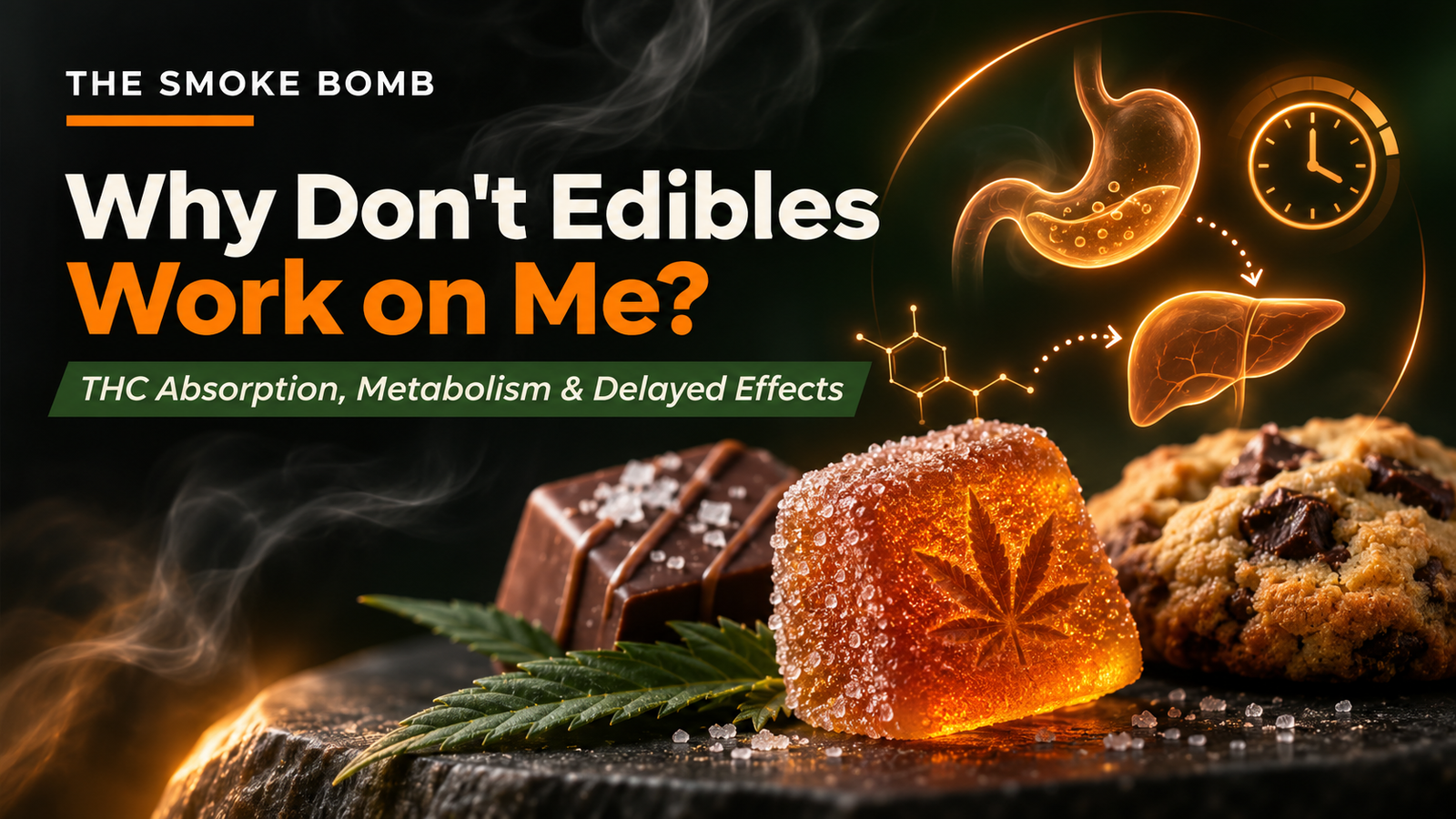
Why do THC edibles sometimes have no effect? Explore edible absorption, liver metabolism, food, tolerance, genetics and delayed effects.
Why Don’t Edibles Work on Me? THC Absorption and Metabolism Explained
You eat a THC gummy, wait an hour, and nothing happens. Another hour passes. Still nothing. Meanwhile, someone who consumed the same product says they’re feeling the effects.
If you’ve ever wondered, “Why don’t edibles work on me?” you’re asking a question that researchers have been investigating through studies of THC absorption, liver metabolism, and individual responses to cannabinoids.
Cannabis edibles can produce weak, delayed, or inconsistent effects because THC must pass through the digestive system before reaching the bloodstream. Food intake, product formulation, liver metabolism, previous THC exposure, and individual physiology can all influence the experience.

And sometimes, the edible simply hasn’t reached its full effect yet.
According to Health Canada, orally consumed cannabis generally begins producing effects within 30 minutes to two hours, but reaching the full effect can take up to four hours. The effects can last up to 12 hours, with some residual impairment lasting into the following day.
Taking more because nothing seems to be happening can therefore lead to unexpectedly strong intoxication.
So why does an edible work well for one person but barely affect another? The answer begins with what happens to THC after you swallow it.
Why Do THC Edibles Sometimes Have No Effect?
THC edibles may appear ineffective because the body absorbs and processes orally consumed cannabis differently from inhaled cannabis.
When someone smokes or vapes cannabis, THC passes through the lungs and enters the bloodstream relatively quickly.
An edible takes a different route.
The THC must be released from the food or beverage, move through the digestive system, cross the intestinal lining, and undergo metabolism before producing its effects.
Several biological processes influence how much THC eventually reaches the bloodstream and how quickly it does so.
The most relevant explanations include:
- Delayed absorption: THC may not reach an effective concentration in the bloodstream as quickly as expected.
- Variable bioavailability: Only a portion of orally consumed THC reaches systemic circulation unchanged.
- Food and digestion: The contents of the stomach and the composition of a meal can change THC absorption.
- Individual metabolism: Liver enzyme activity and other physiological differences can affect cannabinoid processing.
- Cannabis tolerance: Repeated THC exposure can reduce sensitivity to some of its effects.
- Product differences: Edible formulations and inaccurate THC labelling can complicate expectations.
- Different subjective responses: Some people may experience impairment or other effects without the familiar sensation of being high.
These factors can overlap.
For example, someone with an established THC tolerance may consume an edible after a large meal and notice little effect during the first two hours. That experience does not establish whether tolerance, delayed absorption, or both are responsible.
A systematic review published in 2020 examined 26 human studies involving orally administered cannabis and THC.
Researchers found substantial variability in oral THC pharmacokinetics, including differences in absorption between capsules, baked goods, oils, and other formulations.
The review concluded that oral THC has a highly variable pharmacokinetic profile, with particularly notable differences among some food-based and oil-based preparations.
Source: Oral Administration of Cannabis and THC Preparations: A Systematic Review.
This variability helps explain why the same labelled amount of THC does not always produce the same experience.
Can Someone Be Naturally Resistant to Cannabis Edibles?
Some people report that cannabis edibles have little noticeable effect on them, even when inhaled cannabis produces the expected intoxication.
However, scientists have not established a recognized condition that makes otherwise healthy individuals universally immune to oral THC.
Differences in absorption, metabolism, tolerance, and sensitivity may contribute to unusually weak responses.
Researchers are still investigating how genetic differences and other biological factors influence cannabis pharmacology.
The important distinction is that a self-reported lack of intoxication is not evidence that THC has failed to enter the bloodstream or that the person is unaffected.
A person can experience changes in coordination, judgement, or reaction time without feeling strongly intoxicated.
How Does Your Body Absorb THC From Edibles?
The digestive system plays a central role in determining how THC from cannabis edibles reaches the bloodstream.
Unlike water-soluble compounds, THC is highly lipophilic, meaning it dissolves more readily in fats than in water.
This characteristic influences how THC behaves inside the digestive tract, how it crosses biological membranes, and how it moves through the body.
The journey involves several connected stages.
1. The Digestive System Releases THC From the Edible
After someone swallows a cannabis gummy, chocolate, brownie, or infused beverage, the product enters the gastrointestinal tract.
The edible’s ingredients and physical structure influence how its contents become available for absorption.
THC must separate from the food matrix or formulation before it can be absorbed.
Because edible products are manufactured using different ingredients and processing methods, their absorption characteristics are not necessarily identical.
This is one reason why comparing cannabis edibles based only on their labelled THC content can be misleading.
Two products may contain the same declared amount of THC but produce different concentration-time profiles in the bloodstream.
2. THC Is Absorbed Through the Intestines
Most orally consumed THC is absorbed through the gastrointestinal tract, particularly the small intestine.
However, the proportion that reaches systemic circulation unchanged is limited.
Health Canada’s guidance for healthcare professionals describes oral THC absorption as slow and variable.
It cites research involving THC consumed in a chocolate cookie, where systemic availability was estimated at approximately 4% to 12%.
In practical terms, oral bioavailability describes how much of an administered substance reaches systemic circulation unchanged.
It does not measure how much of the edible was digested, and it does not directly predict how intoxicated someone will feel.
A low percentage of unchanged THC in systemic circulation also does not mean that the remainder has no pharmacological relevance. Some THC undergoes conversion into active metabolites.
Source: Health Canada: Information for Health Care Professionals on Cannabis and Cannabinoids.
3. The Liver Converts Some THC Into 11-Hydroxy-THC
After absorption, much of the THC entering the portal circulation travels to the liver before reaching the wider bloodstream.
This process is called first-pass metabolism.
Liver enzymes transform THC into several metabolites, including 11-hydroxy-THC, commonly written as 11-OH-THC.
This metabolite is pharmacologically active and contributes to the effects of orally consumed cannabis.
That distinction matters because the intoxicating effects of edibles are not determined solely by the concentration of unchanged THC.
Both THC and active metabolites can influence the overall experience.
Health Canada explains that ingestion produces a different cannabinoid exposure profile from inhalation, contributing to the delayed and potentially prolonged effects of edibles.
However, higher production of an active metabolite does not guarantee that every person will experience stronger intoxication.
The relationship between cannabinoid concentrations, receptor activity, and subjective effects remains complex.
Does Eating Before Taking an Edible Change How It Works?
Yes. Food can substantially change THC absorption, including the amount reaching the bloodstream and the time required to reach peak concentrations.
This is one of the most useful findings for understanding inconsistent edible experiences.
THC is fat-soluble, and the presence of food can influence gastrointestinal processing and the absorption of oral cannabinoid formulations.
However, the effect is not as simple as saying that eating always makes edibles stronger or that an empty stomach always makes them work faster.
Different formulations can behave differently.
What Does Research Say About THC Edibles and Food?
A controlled pharmacokinetic study published in Clinical Pharmacology: Advances and Applications investigated how food affected oral dronabinol, a pharmaceutical formulation of THC.
Researchers collected pharmacokinetic data from 54 healthy volunteers.
Compared with the fasted condition, overall THC exposure increased approximately 2.1- to 2.4-fold under the tested fed conditions.
Food also delayed the time required to reach peak blood concentrations.
These results show that eating can change both THC exposure and absorption timing.
However, the study involved pharmaceutical THC formulations, not every type of recreational cannabis gummy or baked good.
Its findings should not be used to predict a precise increase in intoxication from an ordinary meal.
Source: Effect of Food on the Pharmacokinetics of Dronabinol Oral Solution Versus Capsules.
Do Edibles Work Better on an Empty Stomach?
Not necessarily.
An empty stomach may change how quickly certain oral THC formulations are absorbed, but a faster absorption process does not automatically mean greater total exposure or stronger effects.
Studies involving pharmaceutical THC have found that food can delay peak concentrations while increasing overall exposure.
This means someone could experience a slower onset after eating but still have substantial cannabinoid exposure later.
Taking THC on an empty stomach also does not eliminate the possibility of delayed or unexpectedly strong effects.
There is no reliable universal rule for using meal timing to predict cannabis intoxication.
Does Eating Fatty Food Make Edibles Stronger?
Some clinical studies have found increased THC exposure when oral THC formulations were administered with high-fat meals.
For example, a human pharmacokinetic study published in Cannabis and Cannabinoid Research investigated THC capsules taken under fed and fasted conditions.
Researchers found that a high-fat meal increased overall THC exposure and delayed the time to peak concentrations.
The magnitude of the change depended on the studied dose and pharmacokinetic measurement.
Source: Human Pharmacokinetic Parameters of Orally Administered THC Capsules.
These findings support the conclusion that dietary conditions can affect orally administered THC.
They do not establish that deliberately eating fatty foods is a safe or predictable method of intensifying cannabis effects.
For consumers, the more important lesson is that food introduces another source of variability.
An edible that appears ineffective shortly after a meal may still produce significant effects later.
Increasing the amount before its full effects develop creates an avoidable risk of overconsumption.
Why Do Edibles Take So Long to Kick In?
Edibles usually take longer to produce noticeable effects because THC must pass through gastrointestinal absorption and first-pass metabolism before sufficient cannabinoids reach the brain.
Inhaled cannabis bypasses much of this initial digestive process.
That difference creates two distinct patterns of onset.
| Characteristic | Inhaled cannabis | Edible cannabis |
|---|---|---|
| Main absorption route | Lungs | Gastrointestinal tract |
| Typical onset | Seconds to minutes | 30 minutes to 2 hours |
| Time to full effects | Up to 30 minutes | Up to 4 hours |
| Potential duration | Up to 6 hours | Up to 12 hours |
| Residual effects | May last up to 24 hours | May last up to 24 hours |
Timing is approximate and varies by individual, product, and amount consumed. Source: Health Canada.
Why Might an Edible Seem Ineffective After Two Hours?
Two hours without noticeable intoxication does not necessarily mean the edible contains no active THC.
Health Canada advises that full edible effects can take up to four hours to develop.
Different people also experience cannabinoids differently, so the absence of a familiar high is not proof that no impairment is present.
Consider two people who consume the same labelled amount of THC.
One notices effects after approximately 45 minutes. The other experiences a delayed response and does not notice substantial effects until much later.
Both experiences can fall within the variability associated with oral cannabis.
This is why consuming additional THC before the initial amount has reached its full effect can be dangerous.
The effects may overlap and become considerably stronger than expected.
Health Canada recommends choosing products containing 2.5 mg THC or less for people seeking to minimize risk, allowing sufficient time for effects to develop, and avoiding additional consumption before the full effects are understood.
Source: Health Canada: Cannabis, Lower Your Risks.
Can Your Genetics Explain Why Edibles Don’t Work on You?
Genetics can influence how the body processes THC, but scientists have not identified a single gene that reliably explains why someone feels little or nothing after consuming cannabis edibles.
Much of the research focuses on liver enzymes involved in cannabinoid metabolism.
Two important enzyme families are CYP2C9 and CYP3A4, which belong to the cytochrome P450 system. These enzymes help transform THC into metabolites that the body can process and eventually eliminate.
People inherit genetic variations that may influence how efficiently certain enzymes function.
These differences can affect cannabinoid concentrations in the bloodstream, although the relationship between enzyme activity and subjective intoxication is more complicated.
What Is CYP2C9, and How Does It Affect THC Metabolism?
CYP2C9 is a liver enzyme involved in the metabolism of several medications and compounds, including THC.
Variations in the CYP2C9 gene can change enzyme activity.
A human study published in Clinical Pharmacology & Therapeutics investigated how CYP2C9 genetic polymorphisms influenced orally administered THC.
Researchers examined 43 healthy volunteers and compared cannabinoid pharmacokinetics across different genetic groups.
They found that participants carrying two copies of the CYP2C93 variant had approximately threefold greater THC exposure than participants with the CYP2C91/*1 genotype.
The study also identified differences in THC metabolite concentrations and a trend toward increased sedation among CYP2C9*3 carriers.
This study provides evidence that inherited differences can affect the body’s exposure to THC.
However, it does not establish that people with particular CYP2C9 variants are immune to cannabis edibles.
In fact, the researchers observed greater THC exposure in participants with one reduced-function genotype.
Genetics may help explain some differences in cannabinoid processing, but it cannot currently provide a simple answer to why a particular edible did not produce noticeable intoxication.
Can Your Liver Metabolize THC Too Quickly?
It is biologically plausible that differences in liver enzyme activity could influence THC concentrations and the duration of exposure.
However, describing someone as a fast THC metabolizer is not enough to explain an apparently ineffective edible.
THC metabolism produces compounds with different pharmacological properties.
For example, 11-hydroxy-THC is an active metabolite, whereas 11-nor-9-carboxy-THC, often called THC-COOH, is not intoxicating.
Faster conversion of THC does not necessarily mean weaker overall cannabinoid effects, because the resulting metabolites also matter.
The timing of absorption, the amount entering circulation, and sensitivity to cannabinoids must all be considered.
Research has not established a validated consumer test that determines whether an individual’s liver processes edibles too quickly for intoxication to occur.
Anyone concerned about unusual medication or cannabis responses should discuss them with a qualified healthcare professional rather than attempting to identify a metabolic condition through increasingly large THC amounts.
Does Cannabis Tolerance Affect How Edibles Work?
Yes. Regular THC consumption can reduce sensitivity to some cannabinoid effects, including those experienced after consuming edibles.
THC produces many of its effects by interacting with cannabinoid type 1 receptors, commonly called CB1 receptors.
Repeated THC exposure can lead to changes in receptor signalling and availability.
These biological adaptations contribute to cannabis tolerance.
A systematic review published in Neuroscience & Biobehavioral Reviews found that regular cannabis consumers generally experienced less pronounced acute effects than people who consumed cannabis less frequently.
However, tolerance varied depending on the particular effect being measured.
Source: Cannabis Use and the Development of Tolerance: A Systematic Review of Human Evidence.
Can Smoking Weed Every Day Make Edibles Feel Weaker?
Daily or frequent THC exposure may contribute to tolerance that affects the response to edible cannabis.
Although inhaled and orally consumed THC follow different absorption pathways, both ultimately interact with the endocannabinoid system.
This means someone who regularly smokes cannabis may also experience reduced sensitivity to some effects of oral THC.
However, the relationship is not perfectly predictable.
Edible products produce different concentration-time profiles and involve greater first-pass metabolism than inhaled cannabis.
These differences can make an edible feel unfamiliar, even to an experienced cannabis consumer.
Importantly, there is insufficient research to establish an exact conversion between smoking tolerance and edible tolerance.
Someone who frequently smokes cannabis should not assume they can safely tolerate a large amount of edible THC.
Can You Be Tolerant to Edibles but Not Smoking?
Different subjective responses are possible, but they do not necessarily mean someone has developed two completely independent forms of THC tolerance.
A person might notice stronger effects from inhaled cannabis because THC reaches the bloodstream quickly.
The same person might describe an edible as weak because its effects develop gradually or feel different.
Product formulation, cannabinoid concentrations, metabolism, and expectations may contribute to the difference.
It is more accurate to think of THC tolerance as an adaptation involving shared biological pathways, with the experience modified by the way cannabis is consumed.
For a closer explanation of receptor changes and recovery, see our guide to why weed tolerance becomes so high.
Do THC Gummies, Chocolates, Oils, and Cannabis Drinks Work Differently?
Yes. The type of edible formulation can influence how cannabinoids are absorbed and how quickly they appear in the bloodstream.
THC is poorly soluble in water, which creates challenges for oral delivery.
Manufacturers use different ingredients and processing techniques to incorporate cannabinoids into products.
These formulations can affect how THC is released, dispersed, and absorbed during digestion.
A gummy, chocolate, oil capsule, and cannabis beverage may therefore produce different pharmacokinetic profiles, even when their labels indicate comparable THC amounts.
However, appearance alone does not establish how a product will behave.
Why Might THC Gummies and Chocolates Feel Different?
Gummies and chocolates differ in their ingredients, fat content, and physical structure.
These factors may influence how THC is released from the product during digestion.
For example, chocolate typically contains substantial fat, while conventional gummies often rely on gelatin or pectin-based formulations.
However, THC may already be incorporated into an oil, emulsion, or another carrier before it is added to either product.
That makes the final formulation more important than simply whether the edible is a gummy or chocolate.
There is insufficient evidence to conclude that cannabis chocolates always produce stronger effects than gummies, or that gummies consistently take longer to work.
The most defensible conclusion is that formulation can contribute to variability.
Do Nanoemulsified THC Drinks Work Faster?
Some specially formulated cannabinoid products can change absorption characteristics compared with conventional oil-based products.
Nanoemulsions and related delivery systems are designed to disperse poorly water-soluble compounds into very small droplets or other structures.
These technologies may improve how cannabinoids mix with gastrointestinal fluids.
A 2025 crossover study compared a self-nanoemulsifying THC/CBD powder with conventional oil-based drops in 14 healthy volunteers.
Each participant received formulations containing 8 mg THC and 8 mg CBD during separate study sessions.
Researchers found substantially greater peak THC concentrations with the self-emulsifying formulation.
The time required to reach peak concentrations of 11-hydroxy-THC was also shorter.
This study offers useful evidence that formulation technologies can influence cannabinoid absorption.
However, it was small, tested specific formulations, and should not be interpreted as proof that every cannabis drink marketed as nanoemulsified produces faster or more reliable intoxication.
Nor does faster absorption establish that a product is safer.
Does the Amount of THC on the Label Always Match the Product?
Not necessarily. THC labelling accuracy depends on manufacturing controls, product testing, regulatory oversight, and the reliability of the supply chain.
An influential 2015 study published in JAMA examined 75 medical cannabis edible products purchased in San Francisco, Los Angeles, and Seattle.
Only 17% of the products met the researchers’ criteria for accurate THC labelling.
Approximately 60% contained less THC than labelled, while 23% contained more.
Source: Cannabinoid Dose and Label Accuracy in Edible Medical Cannabis Products.
These results demonstrate why labelled THC content cannot always be assumed accurate across unregulated or poorly controlled markets.
However, the study predates Canada’s regulated recreational cannabis market and does not describe the current accuracy of legally manufactured Canadian cannabis edibles.
In Canada, legally sold cannabis products must meet applicable packaging, labelling, and quality requirements.
Consumers should verify that products come from authorized sources and check the THC content, packaging, and mandatory excise stamp.
In Nova Scotia, the Nova Scotia Liquor Corporation (NSLC) is the authorized recreational cannabis retailer.
What Should You Do If an Edible Isn’t Working?
If a THC edible appears ineffective, the safest response is not to immediately consume more.
Delayed absorption is a well-established feature of edible cannabis, and the effects may continue developing for several hours.
Health Canada advises that it can take up to four hours to feel the full effects of orally consumed cannabis.
Additional THC consumed before those effects develop may result in unexpectedly intense intoxication.
Six Things Worth Checking
1. How much time has passed?
An edible that produces no noticeable effects after 45 minutes may still be undergoing digestion and absorption. Do not assume an early lack of effects means the THC is inactive.
2. What does the label actually say?
Check the amount of THC per serving and per package, not just the weight of the gummy or chocolate. Also distinguish THC content from CBD content.
3. Was the product obtained from an authorized source?
Unregulated products may have unreliable cannabinoid concentrations or contain undisclosed substances. In Nova Scotia, recreational cannabis is legally available through the NSLC.
4. Could food or the formulation have influenced absorption?
Meal composition and product formulation can influence THC absorption. However, these factors cannot reliably predict how a particular person will feel.
5. Is regular THC exposure contributing to tolerance?
Frequent cannabis consumption may reduce sensitivity to some intoxicating effects. Tolerance is not a reason to assume that consuming a large amount of edible THC is safe.
6. Are medications or health conditions relevant?
Some medications and health conditions may affect cannabinoid metabolism or increase the risk of adverse effects. A pharmacist or healthcare professional can assess potential interactions.
These questions can help identify possible explanations, but they do not provide a method for predicting intoxication or choosing a larger THC amount.
When Should You Seek Medical Attention?
Cannabis overconsumption can cause severe anxiety, panic, confusion, vomiting, rapid heartbeat, and other distressing symptoms.
Although serious outcomes are less common than mild or moderate adverse effects, cannabis poisoning can require medical assessment.
Stop consuming cannabis and seek medical advice if concerning symptoms develop.
Call emergency services for chest pain, difficulty breathing, seizures, loss of consciousness, or severe confusion.
If a child accidentally consumes cannabis edibles, contact a poison control centre or obtain urgent medical advice, even if symptoms have not yet appeared.
Health Canada also recommends storing edible cannabis in its original child-resistant packaging, securely away from children and pets.
Source: Health Canada: Cannabis Health Effects and Cannabis Poisoning.
Frequently Asked Questions About Edibles Not Working
Why Can’t I Get High From Edibles but Smoking Works?
Inhaled THC enters the bloodstream rapidly through the lungs, while edible THC must pass through gastrointestinal absorption and liver metabolism. Differences in timing, formulation, active metabolites, tolerance, and individual physiology can affect the experience. Researchers have not established a single explanation that applies to everyone.
Can You Be Immune to THC Edibles?
There is no established medical diagnosis of universal immunity to THC edibles. Some people report unusually weak subjective responses, but this does not demonstrate that THC was not absorbed or that the person experienced no impairment.
Why Did Edibles Work Yesterday but Not Today?
The response to oral THC can vary between occasions. Food intake, product formulation, cannabinoid exposure, tolerance, and other physiological factors may contribute. Even identical labelled THC amounts do not guarantee identical effects.
Can Stomach Problems Affect Edible Absorption?
Digestive conditions may alter the way substances move through or are absorbed from the gastrointestinal tract. However, research specifically connecting individual gastrointestinal disorders with ineffective cannabis edibles remains limited. Persistent digestive symptoms or unusual medication responses warrant medical assessment.
Does Taking Edibles on a Full Stomach Stop Them From Working?
No. Food can delay THC absorption and may increase overall THC exposure for certain formulations. A full stomach does not reliably prevent intoxication. Effects may simply develop later than expected.
Can Liver Enzymes Prevent Someone From Feeling Edibles?
Liver enzymes influence THC metabolism, but current research does not support diagnosing an absence of edible effects solely from presumed fast metabolism. Genetic and metabolic differences can alter THC and metabolite concentrations, yet these changes do not predict subjective intoxication reliably.
Why Do THC Drinks Sometimes Feel Different From Gummies?
Some cannabis beverages use formulations designed to disperse cannabinoids differently from conventional food-based edibles. These differences may affect absorption. However, not all cannabis drinks use the same technologies, and faster onset cannot be assumed from the product category alone.
Do Edibles Work Differently for People With High THC Tolerance?
They can. Repeated THC exposure may reduce sensitivity to some cannabis effects, while oral absorption and metabolism can still produce distinct experiences. High tolerance does not eliminate the possibility of impairment or adverse reactions.
Can CBD Cancel the Effects of THC Edibles?
CBD can influence some effects of THC under certain conditions, but human research is mixed. The outcome depends on factors such as cannabinoid amounts, ratios, and administration methods. CBD should not be considered a reliable antidote to THC intoxication.
How Long Should You Wait Before Deciding an Edible Hasn’t Worked?
Health Canada advises that edible cannabis can take up to four hours to reach its full effects. The absence of noticeable intoxication early in that period does not mean the product is inactive. Consuming additional THC too soon increases the risk of overconsumption.
The Bottom Line: Why Edibles Don’t Work the Same for Everyone
If cannabis edibles seem to have little or no effect, there may be more than one explanation.
Oral THC absorption is variable. Liver metabolism changes the compounds circulating in the bloodstream. Food, product formulation, previous cannabis exposure, and individual physiology can all influence the experience.
Genetic differences may also matter, although scientists cannot currently identify a person’s edible response from a single gene or enzyme.
The most important distinction is between an edible that has not produced noticeable intoxication and one that has not been absorbed.
Those are not necessarily the same thing.
Research demonstrates that cannabinoid absorption can vary substantially between people and formulations. It also shows why taking additional THC before the original amount reaches its full effect can be risky.
Understanding these differences is more useful than assuming that stronger edibles, larger amounts, or particular foods will solve the problem.
A weak or delayed high is not proof of zero THC exposure, and feeling unaffected does not guarantee that someone is unimpaired.