FREE SHIPPING ON ORDERS OVER 100$ IN HALIFAX, NS
FREE SHIPPING ON ORDERS OVER 200$ CANADAWIDE
COLLECT POINTS ON EACH PURCHASE
REFER A FRIEND AND EARN POINTS
CANADAWIDE EXPRESS SHIPPING


How Long Does Weed Stay in Your System? THC Detection Times

Learn how long cannabis stays in your system based on usage, metabolism, and test type. Accurate THC detection times for urine, blood, and saliva.
Used weed recently and now thinking about a drug test?
This is where things get confusing fast.
Some people say a few days.
Others say a month.
Both can be true.
The real answer depends on your body and your habits, not just the weed itself.
Quick Answer
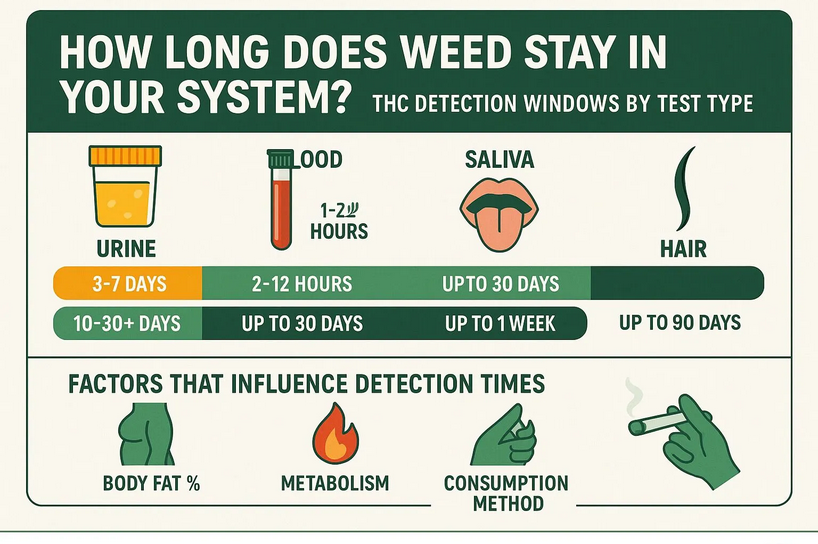
Weed stays in your system for 1–3 days for occasional users, 7–21 days for regular users, and up to 30–45 days for heavy users. Detection time depends on body fat, metabolism rate, usage frequency, and test type, including urine, blood, saliva, or hair testing.
What “Staying in Your System” Actually Means
Most people are not asking how long the high lasts.
They are asking:
Will I pass a drug test?
That is a different thing.
Your body breaks THC down into metabolites. The main one is called THC-COOH. That is what most tests look for.
Even after you feel completely normal, those metabolites can still be sitting in your body.
The Real Detection Windows (No Fluff)
Let’s break this down properly.
Urine Test (Most Common One)
This is where most people get caught off guard.
- Once in a while: 1 to 3 days
- A few times a week: about a week
- Daily use: 3 to 4 weeks, sometimes longer
Urine tests do not look for THC itself. They look for what your body leaves behind.
Blood Test
- Occasional use: about 24 hours
- Frequent use: up to a week
Blood tests track active THC, not long-term buildup.
Saliva Test
Used a lot for roadside checks.
- Light use: 1 to 2 days
- Heavy use: up to 3 days
Hair Test
This one goes way back.
- Up to 90 days
Not very common, but it exists.
Why Weed Stays Longer Than You Expect
This is the part most articles skip.
THC behaves differently than most substances.
It does not just pass through your system.
It gets stored.
Specifically, in fat cells.
That means your body slowly releases it over time. Not all at once.
So even if you stopped days ago, your body might still be processing what is left.
What Actually Changes Your Detection Time
This is where things get personal.
Two people can smoke the same amount and test completely different.
Here is why:
How Often You Use
This is the biggest factor.
- One-time use clears fast
- Daily use builds up over time
Body Fat
More fat = more storage space for THC metabolites
This is not talked about enough, but it matters.
Your Metabolism
Some people process things faster. Others don’t.
There is no fixed rule here.
THC Strength
Higher potency means more THC entering your system.
That usually means longer detection.
How You Consume It
Smoking vs edibles can change how your body absorbs and processes THC.
Edibles tend to stay in your system longer.
Can You Speed It Up?
Short answer: not really.
There is a lot of bad advice online.
Drinking tons of water will not magically clear THC. It might dilute your sample, but that can also raise red flags.
Detox drinks? Hit or miss.
Exercise? It can actually release stored THC temporarily.
The only reliable factor is time.
Effects vs Detection (Big Difference)
This is where people get misled.
You might feel fine after a few hours.
But that does not mean your system is clear.
Effects
- Smoking: a few hours
- Edibles: longer, sometimes half a day
Detection
- Days to weeks
You can feel completely sober and still test positive.
Why Occasional Users Have It Easier
If you only use occasionally, your body clears THC faster.
There is less buildup.
Heavy users are dealing with accumulation.
That is why detection stretches into weeks, not days.
Can Secondhand Smoke Make You Fail?
In normal situations, no.
You would need extreme exposure in a closed space.
Even then, it is unlikely to reach testing thresholds.
Takeaway
There is no universal timeline.
Anyone giving you one number is oversimplifying it.
What matters most:
- How often you use
- Your body composition
- The type of test
If there is one thing to remember:
Weed leaves your mind faster than it leaves your body.
How long does weed stay in urine?
For occasional users, about 1 to 3 days. For heavy users, it can stay for 30 days or more.
How long does THC stay in blood?
Usually up to 24 hours, but frequent users may show traces for several days.
Can you flush THC out faster?
There is no proven way to speed up THC removal. Time is the main factor.
Does body fat affect THC detection?
Yes. THC metabolites are stored in fat, which can extend how long they stay in your system.
How long does weed stay in saliva?
Typically 24 to 48 hours, sometimes up to 72 hours in heavy users.
Research-Based Citations for THC Detection and Metabolism
| # | Citation | Key Focus |
|---|---|---|
| 1 | Berchansky, M., et al. (2026). Detection of Δ9-Tetrahydrocannabinol Impairment Using Portable fNIRS Neuroimaging. | 2026 research in Scientific Reports discussing the limitations of traditional biological testing (blood/saliva) and the development of neuroimaging for more accurate detection of active THC impairment. |
| 2 | Goodpaster, K. P. S., et al. (2025). Cannabis, Weight, and Weight-Related Behaviors: A Clinical Review. | Clinical review in Journal of Cannabis Research analyzing the relationship between cannabis use, body mass index (BMI), and lipid metabolism, which directly impacts THC storage in adipose tissue. |
| 3 | Fisher, R. (2025). What is a “cannabis user”? Inaccuracies in biological tests and clinical definitions. | 2025 study in Clinical Therapeutics highlighting the variability in biological test results and the challenges of defining detection windows due to differences in user frequency and metabolism. |
| 4 | Castro, N. I. Q., et al. (2025). A Systematic Review and Meta-Analysis of Cannabis Use and Metabolic Health. | Meta-analysis in Frontiers in Endocrinology documenting how regular cannabis use correlates with lower BMI and altered fat metabolism, factors that influence the “re-release” of THC from body fat. |
| 5 | Voutilainen, M., et al. (2024). Comparing Hair, Urine & Saliva Drug Testing: Detection Windows and Thresholds. | Technical review of detection windows, confirming that THC is detectable in urine for 1–30+ days depending on frequency, while saliva and blood windows are typically limited to 2–24 hours. |
| 6 | Knutsen, H. K., et al. (2025). Scientific Opinion on the Derivation of Health-Based Guidance Values for Δ9-THC. | 2025 scientific opinion from the European Food Safety Authority (EFSA) on the pharmacokinetics and elimination rates of THC, providing a basis for standardizing detection thresholds. |
| 7 | Upadhyay, G., et al. (2025). Cannabis inhalation disrupts bioactive lipid metabolism and immune activity. | Research in Life Sciences exploring how cannabis consumption impacts multi-organ lipid metabolism, which affects the long-term sequestration and excretion of THC metabolites. |
| 8 | Healthline (2024). How Long Does Weed (Marijuana) Stay in Your System? | Comprehensive clinical guide summarizing detection windows: 1–3 days for occasional users in urine, up to 30+ days for chronic users, and up to 90 days in hair follicles. |
Sources
- National Institute on Drug Abuse
https://nida.nih.gov/publications/research-reports/marijuana/how-long-does-marijuana-stay-in-your-system - Centers for Disease Control and Prevention
https://www.cdc.gov/marijuana/health-effects/index.html - Health Canada
https://www.canada.ca/en/health-canada/services/drugs-medication/cannabis/laws-regulations.html - Canadian Centre for Occupational Health and Safety
https://www.ccohs.ca/oshanswers/psychosocial/cannabis.html